Many modern Russian Orthodox Christians often act as if their church is untouched by the influence of Latin Christendom, claiming to be the legitimate heirs of the authentic Slavic Christian tradition. But the reality of contemporary Muscovite Russian Orthodoxy is much more complicated (and Western!) than many of its adherents will admit. Here are a few historical details and reflections on the ample cross-pollination of Latin ideas and customs in the Russian church.
First, regarding theology, the protestations of 21st century “orthobros” and “convertadox” against Thomism notwithstanding, the same Russian church they see as the bastion of anti-Western thought was heavily influenced by not only Greek but Latin Scholasticism. During the Middle Ages and Renaissance, Muscovite Russia was a developing power, and as the church and state established itself, its leaders, noticing the superiority of western Europe, at that time an advanced civilization that had come into its own under the Catholic faith, looked there as an example for ecclesiastical organization. As a result, Russia adopted the model of seminary formation that had developed in the Latin world to foster better formation of its clergy, and some Russian clerics even received training in scholastic philosophy and theology through their studies in the lands of Western Europe. This is likely one of the reasons the Russian church remained connected and even in some kind of communion with the Latin church for centuries after the Greek schism of 1054 AD.
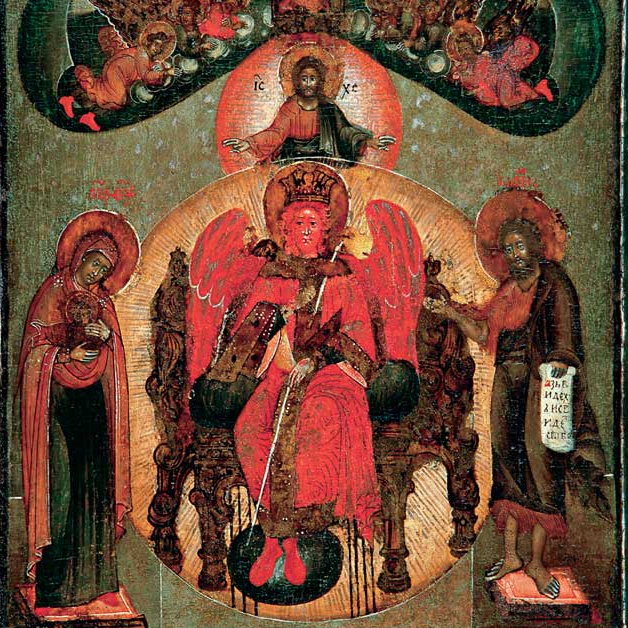
Second, regarding art, Russian iconography was also deeply affected by Western ideas from exposure to second millennium Latin sacred art. In the first millennium, both the Greek and Latin world shared a common style of religious painting (icon) that was characterized by particular colors and highly stylized figures that were depicted in a serene manner as if they were looking out of the image right into the soul of the viewer (sometimes described as “flat,” as in not having depth.) Today people often think this was due to some primitive lack of artistic ability to depict figures and scenes with realistic poses, proportions, and perspective. But this is not the case, as the ancient world produced some of the most realistic sculptures in human history. Rather, the early Christians deliberated chose to depict Christ and the saints in specific stylized ways to communicate particular doctrinal or theological expressions. The iconography existed to show the faithful the meaning of the events or importance of the persons, not to provide a realistic snapshot of a scene. This understanding of sacred art endured throughout most of the medieval world in both East and West, as can be seen in the famous San Damiano crucifix (in the icon style) associated with St. Francis of Assisi. However, in the High Middle Ages and into the Renaissance, artists, like the rest of society, became influenced by the resurgence of interest in the natural sciences, and introduced perspective and other aspects of realism into religious artwork. So, when Russian clerics (and also secular intellectuals who sought closer ties with Western Europe for political reasons) encountered this new style of art, they brought it back home with them, and it became incorporated into the religious tradition, along with Scholasticism. As a result, when visiting many Russian Orthodox churches today, one will see icons with non-traditional but realistic colors and portraits and scenes that draw the viewer in with the impression of depth and activity.
Finally, regarding music, current Russian choral singing is closely modeled after the sacred polyphony that was introduced in the Latin church during the late medieval and Renaissance periods. The original Russian liturgical music, as with all East Slavic Christian traditions, is based in the ancient zhnammeny chant. Old Russian chant, similar to the Greco-Byzantine chant which came before it, has an alien sound that many Western listeners would compare to Middle Eastern or perhaps even Asian music. Like these other non-Western cultures, it did not follow the rules of the diatonic or even the chromatic scale. Rather, it was characterized by modal and microtonal qualities that was not only foreign but quite difficult to fit into Western musical systems. Think of the exotic, improvisatory, and ornamented sound of Arabic chant. However, as the Russian church became exposed to Western ideas through the education of its clergy (and secular intellectuals), its leadership (church and state were united in the Russian empire, so both the Tsar and the hierarchs worked together in symphony) desired to bring liturgical music into conformity with Western models. And in so doing, they pruned away most of the non-Western (arguably the most colorful) aspects of the Russian chant tradition, standardized, and simplied the melodies to fit them into the orderly theoretical and practical systems of Western music composition and notation. This allowed Russian liturgists to then be able write out the music with fixed 4-part (soprano, alto, tenor, and bass) voicings to produce chords that followed the rules of harmonic progression, voice leading, and counterpoint established by Western composers. This gives modern Russian choral music a refined and sober sound reminiscent of Palestrina, Fux, and the other Western exemplars. The Old Russian chant also had harmonies, but these were more in the style of the Greco-Byzantine ison (drone), or were improvised spontaneously following the lead of the Cantor, without a strict set form. Interestingly, both the Russian Old Believers and more importantly our Ruthenian Greek-Catholic Church, with its rich prostopinije (plainchant) tradition, have preserved this earlier practice in their usages, along with elements of the underlying zhnammeny and Greco-Byzantine chant. But we are supposed to be the latinized ones…
Anyway, the moral of the story is that universality is the way forward. Russians have deeply integrated Western ideas and practices, and we Ruthenian Uniates are fully Eastern in our own unique and ancient way. Let us all be true to our traditions in the One, Holy, Catholic and Apostolic Church of Jesus Christ!
S Bohom


Leave a Reply