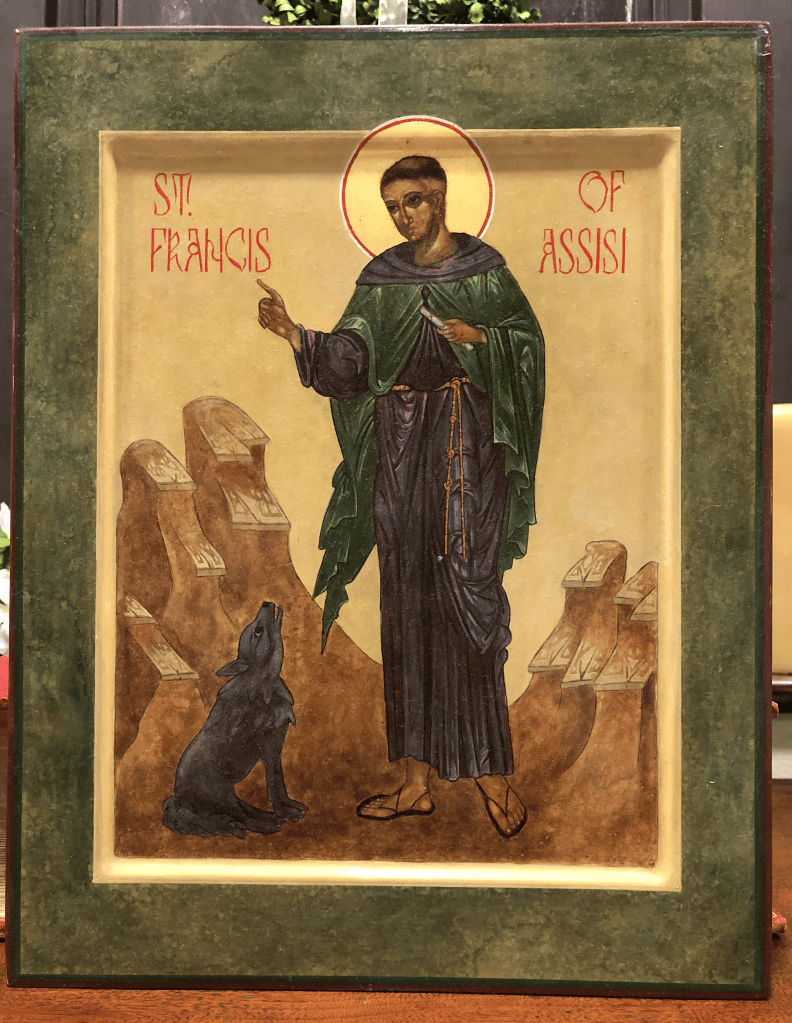
One might wonder why St. Francis, a figure thoroughly embedded in the Latin tradition, is relevant to Eastern Christians. One of St. Francis’ core qualities is his knightly temperament. As a young man, he cherished an ambition to become a soldier serving a temporal lord. He saw this goal as a means for advancement from the new mercantile class to knightly nobility. His family had attained wealth and luxury through his father’s cloth business, but they lacked the social status of the old gentry. Thus, he intended to secure that respect by earning his place at the table of the aristocracy. However, God had other plans for St. Francis. After suffering a humiliating defeat in battle, his sense of his life’s calling was shattered, and he was forced to discern on a deeper level what he was truly meant to do. His defeat humbled him and began to show him his limits. He tried to go off to war again with a new suit of armor, but God called him back to Assisi to begin a greater spiritual battle. St. Francis renounced prideful dreams of earthly glory after his conversion, but his militaristic impulse remained and was sublimated into a higher zeal for the salvation of souls. As part of his missionary zeal to spread the Gospel of Jesus Christ to all mankind, St. Francis was especially concerned with a group of non-Christian peoples who frequently interacted with Europeans: the Arab Islamic world. And to model this mission of universal evangelization to his followers, the simple friar undertook a journey to Egypt and Levant to try and win the hearts of the Mohammedans for Christ. In the course of his Middle Eastern adventures, St. Francis was captured and brought before the Sultan, to whom he preached the Good News. The Sultan did not convert to the true faith, but he was favorably impressed by the friar’s great courage and humility. And while the mission to the Muslims did not result in their return to the Christian fold, St. Francis’ work in the Middle East built foundations of mutual respect and goodwill. As a result, the Franciscans left an abiding presence in the region that endures to this day in their peaceful relations with Islamic and (more recently) Jewish authorities. This presence has resulted in ecumenical partnerships with their brethren from several Eastern Christian Churches, with whom they share custody of the holy places.
But the involvement of St. Francis’s movement with Eastern Christianity was not limited to physical proximity and friendly relations. Franciscan theology also possesses an affinity with Eastern Christianity’s views about the nature of God, the spiritual life, and knowledge. From the beginning, St. Francis’s followers carried on an intense rivalry with the order founded by St. Dominic with a similar purpose of reviving Christian life through evangelical poverty, but especially with their preaching. The Dominican order, with its focus on intellectual training, produced many highly esteemed theologians for the Latin tradition, most notably St. Thomas Aquinas. But unfortunately, many Dominicans developed a negative view of the Greek church’s teachings, and some even came to hold that core Eastern Christian beliefs were erroneous and even heretical. The anti-Greek influence of the Dominican order became so strong that it threatened to derail the Church’s ecumenical efforts to heal the damage done by the Great Schism of 1054 that occurred during the reunion councils of the late Middle Ages and the Renaissance period. The Dominicans took the hardline position that the Greeks could only be brought back into communion in the West if they renounced Palamism and similar Eastern perspectives on the divine nature, among other key Eastern beliefs and practices. The Franciscans, however, led by their great theologian St. Bonaventure of Bagnoregio, took the position that the Greeks were not heretical and could be reconciled in the bonds of charity by accepting the legitimacy of Latin theology and custom and acknowledging the authority of the Pope of Rome. Thankfully, the Pope sided with the Franciscans, with the result that the Latin church extended an olive branch to the separated Eastern Christians with the Second Council of Lyons taking place in 1274. The Franciscan St. Bonaventure was at the forefront of these efforts, and his work resulted in a union agreement. Sadly, this council failed to meaningfully effect the union, but these ecumenical efforts eventually resulted in another “official” reunion between the Latin and Greek churches that took place during the Council of Florence in 1439. Sadly, this union did not hold either, owing to subsequent Greek rejection and the fall of Constantinople. But it bore much fruit over the next several centuries through smaller unions that ultimately resulted in the “de facto” return of large swathes of the Byzantine-Slav church and several of the other smaller Eastern churches to Catholic communion.
In the course of their spread throughout Christendom, the Franciscans established a strong presence in central Europe. During the 16th and 17th centuries, they played an important role in the reunification efforts between the Eastern Christian populations of this region and their Roman Catholic rulers. Carpatho-Rusyn and ethnic Ukrainian groups had fallen under the dominion of the Polish-Lithuanian Commonwealth and the Austro-Hungarian Habsburg Empire and were struggling to work out what it meant to be “Greek-Catholics” loyal to the Pope of Rome and their civil leaders, while remaining faithful to their distinctive Eastern Christian liturgical and spiritual traditions. Crucially, the Franciscan Order had already defended the Ruthenian Christians from religious and political abuses by their overlords. Even before the Unions of Brest and Uzhhorod, the Franciscans in Poland upheld the provisions of the Council of Florence and “resolutely opposed” the notion of rebaptizing the Ruthenians that was advanced by the Polish hierarchy. (Hlaváček, 169) Thus, the Franciscans were instrumental in paving the way for the establishment of the Ruthenian Greek-Catholic Church as an Eastern-Rite community in union with Rome. Over time, this affinity resulted in a mutual exchange and enrichment through the foundation of Byzantine Franciscan branches of the Order. These Byzantine Franciscans became especially influential in the United States through their men’s monastery in Sybertsville, Pennsylvania. The Byzantine Franciscans produced several hierarchs for the Ruthenian Greek-Catholic Church, including the Metropolitan Church of Pittsburgh, currently headed by Metropolitan Archbishop William Skurla, who was formed as a Byzantine Franciscan friar.
Petr Hlaváček, trans. Zdeněk V. David. “Bohemian Franciscans Between Orthodoxy and Nonconformity at the Turn of the Middle Ages.”


Leave a Reply